Spatial Evidence for SLCO Public Safety Stakeholders

Youth with justice system contact share the same risk factors and come from the same neighborhoods

How do we navigate public safety while utilizing community assets that can have a measurable impact on youth and families in Salt Lake County?

CCJJ
scroll to begin ↓
How to use this presentation

How do we hold youth accountable, promote public safety, and intervene at the right windows to reduce contact with the system?

Three parts. One question. Each section builds toward an answer. Click any section to jump ahead, or scroll to explore the full narrative.

1 The Problem

What drives youth violence, where it concentrates, and why these neighborhoods produce repeat contact across generations.

Gang incentives · Maps · Data layers
2 The Mechanism

How structural conditions produce the behaviors the system responds to, and where the interception points are.

Accountability · Pathway · Windows · Causal evidence
3 The Response

What works, what's already working locally, and how to deploy interventions where the data shows the greatest return.

Programs · Local evidence · ROI · Maps
1 The Problem

What drives youth violence, where it concentrates, and why these neighborhoods produce repeat contact

💡

If we want to reduce gang involvement, we have to understand what gangs are replacing — and offer something better.

The incentive structure

Incentives for gang involvement: belonging, safety, purpose, and survival

Gang involvement is a rational response to constrained choice sets. When prosocial pathways to belonging, identity, safety, and economic participation are absent, gangs become the enticing alternative. Effective prevention must restructure the incentive landscape by replacing the returns to gang involvement with higher-return prosocial alternatives.

🤝
Belonging and social capital
Returns to affiliation when family networks are disrupted

When family social capital is depleted by incarceration, addiction, or economic instability, gangs supply the bonding capital that mainstream institutions fail to provide. Alleyne & Wood's Unified Theory identifies protection, status, and social support as core returns, in which the gang functions as a substitute kinship network with enforceable mutual obligations.

Homeboy Industries
Work-therapy, case management, social enterprise employment
70%
non-rearrest
💪
Identity and status acquisition
Returns to identity when legitimate status pathways are closed

When conventional status markers — employment, education credentials, community respect — are inaccessible, gangs offer an alternative status hierarchy with its own currency (reputation, territory, loyalty). Baird (2012) documents this as a rational investment in the only identity market available to socially excluded young men.

Equimundo Manhood 2.0
Gender-transformative curriculum, 2 active US RCTs
9/14
studies show change
🛡️
Security provision
Private protection when public safety institutions fail

In neighborhoods where public safety institutions are absent, under-resourced, or distrusted, gangs function as private security providers. This is a market failure: the state fails to supply the public good of safety, and gangs fill the gap. Especially consequential for refugee and immigrant youth who face both street-level threats and institutional indifference.

Cure Violence — credible messengers
People with lived experience, independent from LE
Sig.
gun violence ↓
💵
Economic participation
Labor market access when formal employment is out of reach

The informal economy becomes the rational labor market of last resort when formal employment is blocked by age restrictions, language barriers, documentation status, criminal records, or geographic isolation from job centers. Barker et al. (2026) found that income from dealing enables independence and status, which is sometimes a more central incentive than belonging itself.

Summer youth employment
Boston SYEP RCT, effects persist 17 months
35%
violence ↓
🌍
Cultural capital and solidarity
Returns to cultural affiliation for displaced and marginalized youth

For Pacific Islander, Latino, Indigenous, and refugee youth, gang structures parallel traditional kinship networks — they are institutional forms that match existing cultural capital. When mainstream institutions fail to recognize or value cultural assets, gangs become the only institution that converts cultural identity into social position. Organizations like PIK2AR succeed because they offer higher returns to the same cultural capital through prosocial channels.

Culturally-specific youth orgs
Community-embedded, mapped by care desert analysis
📍
mapped
🔮
Future orientation and expected returns
Investment in the only institution offering a trajectory

The gang provides expected future returns — a role, a reputation, a trajectory to invest in — when school, employment, and community institutions offer no credible pathway to upward mobility and a future to build towards. In Chetty's framing, these are the neighborhoods where the expected return on "playing by the rules" is near zero. The gang offers a competing investment opportunity with immediate and visible payoffs.

G.R.E.A.T. + mentoring
Prosocial goal-setting, multisite RCT, 7 cities
39%
gang joining ↓

Click any card to expand · Toggle to see matched interventions

The policy implication: Suppression-only strategies are limited in effect because they remove the supply without addressing the demand. Effective prevention must restructure the incentive landscape by offering higher returns to prosocial participation than gang involvement currently provides. The care desert maps identify exactly where those neighborhoods are.

These six incentive domains map onto the risk and protective factor framework identified across the gang membership literature. The Good Lives Model extends this by reframing intervention around building "a life worth living" rather than suppressing risk. Mallion & Wood (2020) →

Open full interactive version →

The gang incentive structure is one manifestation of a broader pattern. The CDC identifies the community conditions that produce it.

The evidence base

Youth violence is not random. It is predictable and preventable.

The CDC identifies risk and protective factors at four levels. Most interventions target individuals. Our spatial analysis targets the level with the largest population impact: community conditions.

👤
Individual
Beliefs, behaviors, history
👥
Relationship
Family, peers, partners
What we measure
🏘️
Community
Neighborhoods, schools, services
🏛️
Societal
Policies, norms, inequality

Community risk factors

Few community activities for young people · Socially disorganized neighborhoods · Diminished economic opportunities · Unstable housing · High rates of existing violence
vs

Community protective factors

Access to mental health services · Caring adults outside the family · Prosocial activities · Quality childcare access · Coordinated community services

CDC Youth Violence: Risk and Protective Factors →

▾ See the full framework: risk and protective factors across all domains
Domain Risk Factors Protective Factors
Individual Offence supportive cognitions, negative life experiences, low self-esteem, internalizing/externalizing behaviors, impulsivity, lack of prosocial activities, PTSD, anxiety, substance misuse, low empathy, high callous-unemotional traits, poor interpersonal skills, anger rumination Effective coping strategies, high emotional competence, emotion regulation skills, resilient temperament, future orientation, impulse control, low ADHD symptomology, high self-esteem, intolerant attitude towards antisocial behavior
Peers Negative peer influence, association with delinquent peer group, victim or perpetrator of bullying, alienation from prosocial peers, strong emotional connection to delinquent peers, peers' substance misuse Interaction with prosocial peer groups, strong social skills, low peer delinquency, prosocial bonding
Family Poor parental supervision and monitoring, lack of attachment to parents, family involvement in street gangs, delinquent siblings, hostile family environment, parental substance misuse, inconsistent discipline, low familial socioeconomic status, single-parent households, childhood maltreatment Strong parental monitoring, control and supervision, parental warmth, cohesiveness within the family, positive parental attachment, stable family structure, low levels of parent-child conflict
School Poor academic attainment, lack of commitment to education, lack of aspirations, unsafe school environment, suspension/exclusion, truancy, inconsistent discipline, victimization at school, inadequate teaching, negative relationships with staff Positive child-teacher relationships, clear familial expectations regarding schooling, personal commitment to education, positive role models, fair treatment from teachers, safe environment, connectedness, regular school participation, academic achievement
Community Disorganized neighborhood, high rates of crime, exposure to street gangs and violence, availability of firearms, poverty, lack of community resources, experiencing unsafe environments Opportunities for prosocial involvement, positive community role models, perceived neighborhood safety, low economic deprivation

Adapted from Mallion & Wood (2020), Table 1. Sources include: Home Office (2015), Lenzi et al. (2018), Mallion and Wood (2018), Melde et al. (2011), Merrin et al. (2015), O'Brien et al. (2013), Raby and Jones (2016), Smith et al. (2019). Good Lives Model: Street gang intervention →

Why we focus on community: Risk and protective factors exist at every level. But individual, peer, and family factors require case-by-case assessment. Community factors can be spatially measured, mapped, and targeted at the population level. Our maps measure exactly where community protective factors are absent — the domain where place-based investment has the widest reach.

Salt Lake County

These are the neighborhoods where youth are most at risk

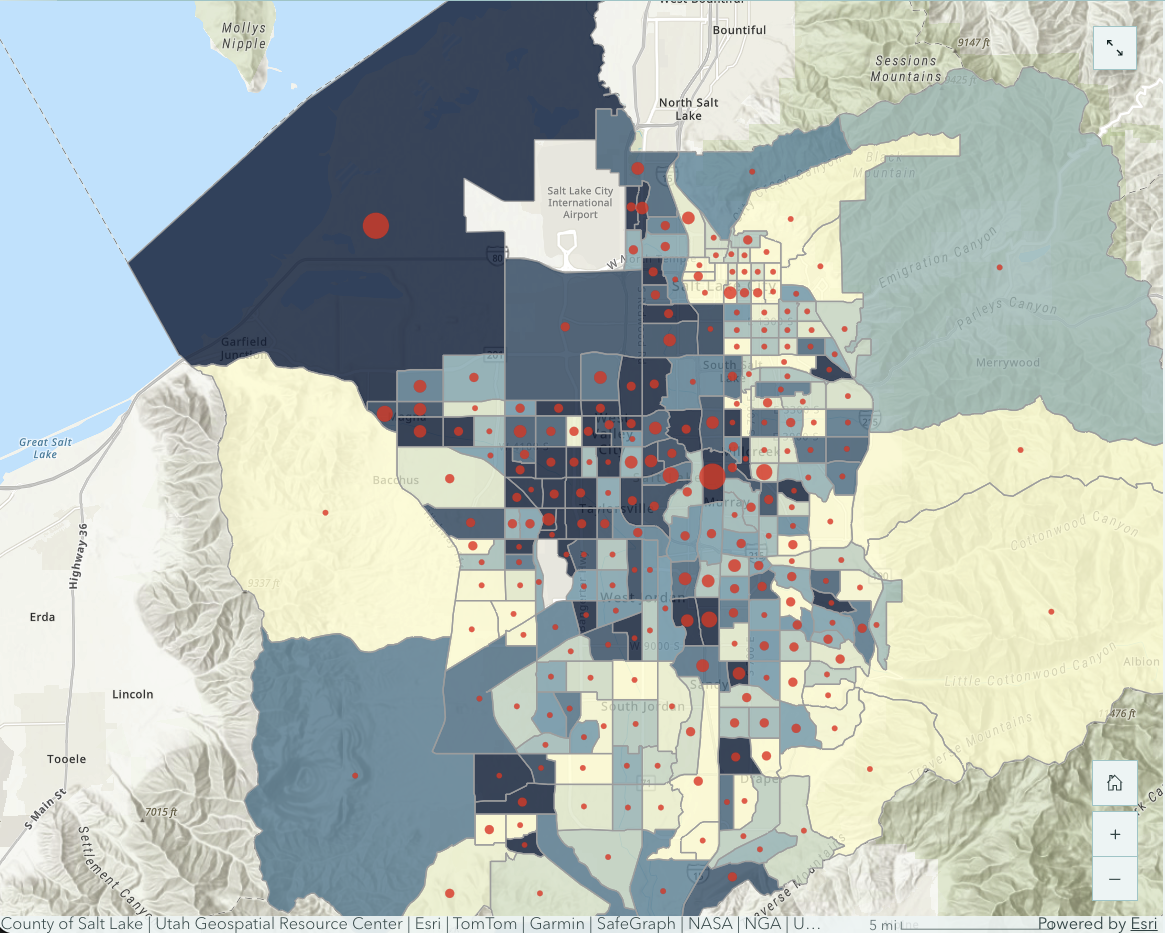
Juvenile court referral hotspots and adult correctional risk converge in the same places. Zoom into Salt Lake County. Drag the slider to compare.

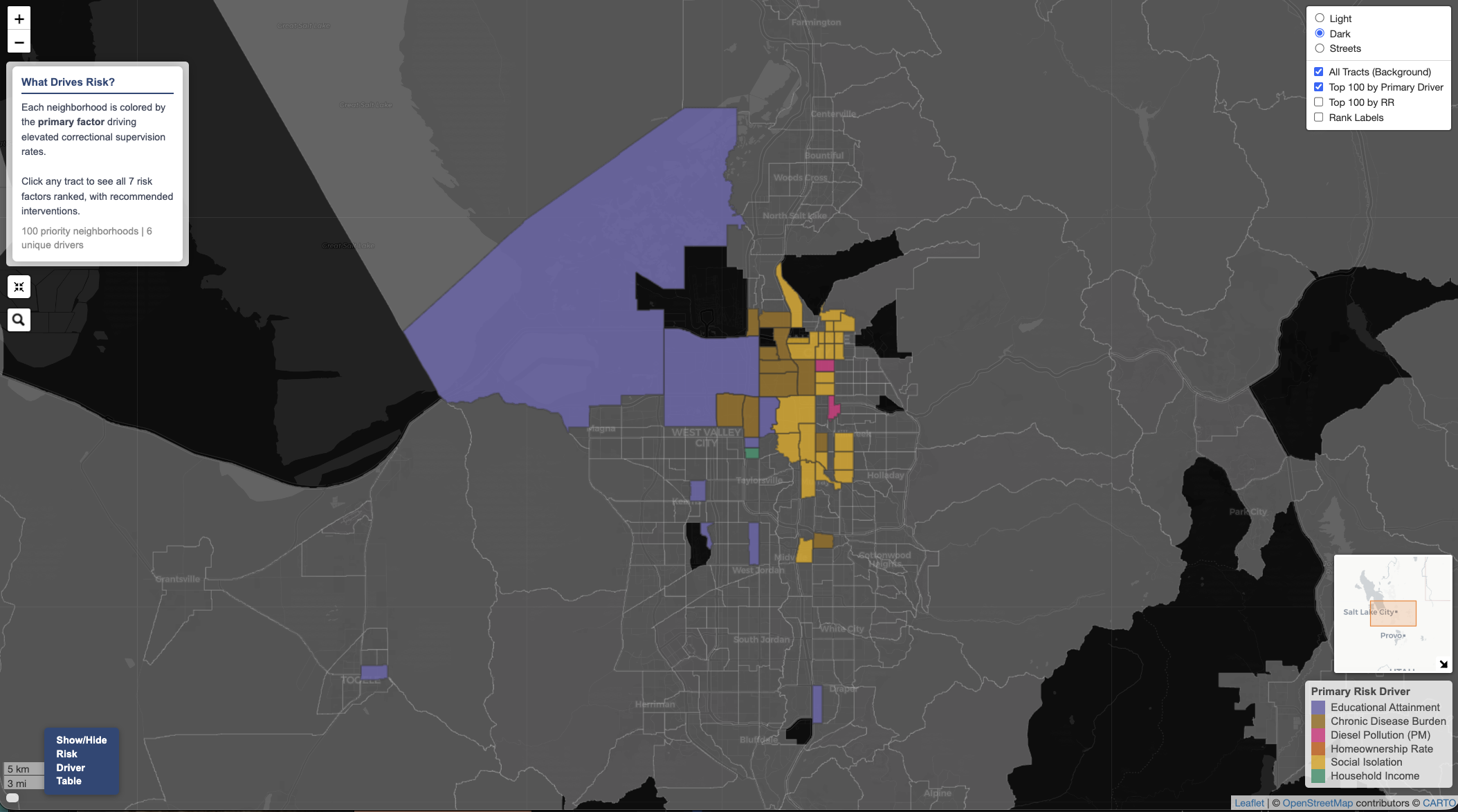
Adult Corrections Risk
Coming Soon
Juvenile Court Referrals Top priority neighborhoods
Adult Corrections Risk Primary risk driver by tract
← drag to compare →
Juvenile Justice Map → Adult Risk Driver Map · Coming Soon
Our spatial approach

We mapped these factors for every census tract in Salt Lake County.

🧒
Youth enrichment reach
🏘️
Community nonprofit density
🩺
Treatment provider access
⚠️
Juvenile serious offenses
👶
Pediatric screening access
⚖️
Juvenile court referrals

Scroll down to explore each layer and see where Salt Lake County's protective infrastructure is strongest and where critical gaps remain.

Let's explore these neighborhoods layer by layer.

Eight layers of spatial evidence · Each narrative card changes the map

Youth Enrichment Reachper 1,000 children · 5mi urban / 10mi rural
Explore full dashboard →
Community Org Reach (Sharkey)per 100,000 pop · 7mi urban / 15mi rural
Explore full dashboard →
School Suspension Rateper 100 enrolled students · CRDC 2020-21
Explore full dashboard →
Referrals to Law Enforcementper 100 enrolled students · CRDC 2020-21
Explore full dashboard →
Pediatric Provider AccessSalt Lake County · 1,075 general + 255 subspecialists · NPPES April 2026
Explore full map →
Adult Corrections Risk Driver Map
Adult Correctional Risk
Interactive map · Coming Soon
Adult Correctional RiskPrimary risk driver by neighborhood · Coming soon
Coming soon
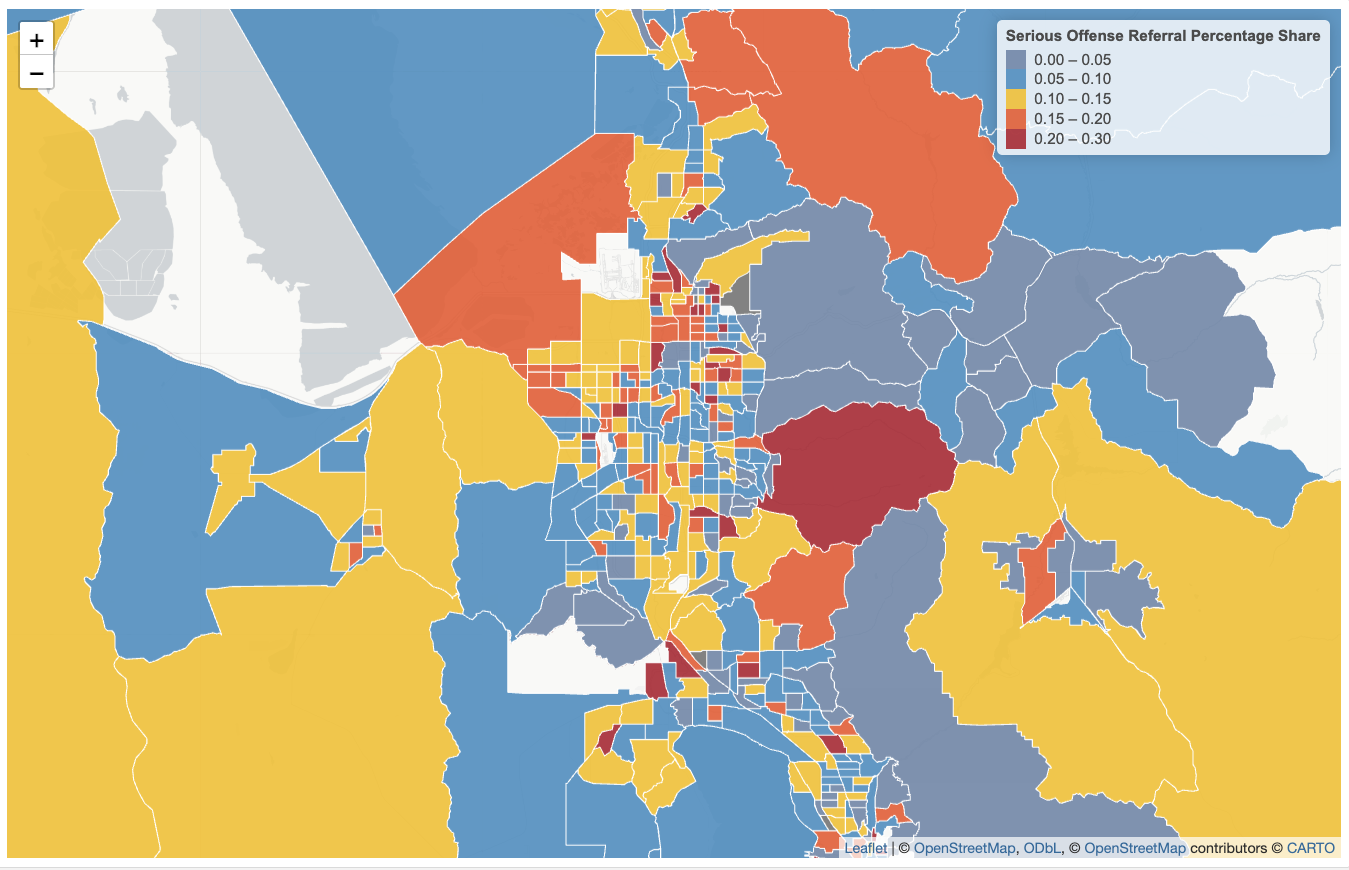
Serious Offense Referral Percentage Share by Census Tract
Serious Offense ReferralsViolent, weapon, or firearm · Percentage share by tract
Explore full map →
Female-Headed Households and Juvenile Court Referrals
Female-Headed HouseholdsSLCO spatial study · Association with juvenile court referrals
SLCO Spatial Study →
Layer 1 · Community safety net

Start here: where can youth access supportive programs?

This map shows youth enrichment reach: how many organizations a child in each neighborhood can actually get to. Green = strong care ecology. Red = care desert.

20

tracts confirmed as care deserts by all four estimation methods

Layer 1 · The evidence

These organizations aren't just nice to have. They reduce violence.

Sharkey's IV design across 264 cities: every 10 additional community nonprofits per 100K → a 9% reduction in murder. Cumulative long-term effects of 12% reduction in homicide, 10% in violent crime, and 7% in property crime. The previous map showed you where they're missing.

9%

Sharkey et al. (2017). American Sociological Review.

Layer 2 · School environment

Now look at the same neighborhoods on a different map.

The care desert tracts from the previous view are the same tracts with the highest suspension rates. Middle schools average 9.9%: nearly 1 in 10 students excluded. The overlap is not coincidental.

9.9%

Middle school avg suspension rate · CRDC 2020-21

Layer 2 · The pipeline

Suspensions become law enforcement referrals.

Schools don't just exclude students; they refer them directly to law enforcement. The same tracts with the highest suspension rates also have the highest school-based LE referral rates.

Referrals to law enforcement · CRDC 2020-21

Layer 3 · Before school even starts

Zoom out. The earliest window is already closed.

Children with neurodevelopmental disorders are at 5× higher risk for mental, emotional, and behavioral problems. Early screenings for ADHD, autism, and learning disabilities are important early prevention windows.

AAP (2025) → · AAP (2020) →

The cycle · Adult outcomes

These similar neighborhoods produce the highest adult correctional rates.

The pattern repeats across generations. Juvenile incarceration decreases high school completion and increases adult incarceration. Concentrated disadvantage effects on recidivism are significant for juveniles but not adults. The neighborhood environments matter most during adolescence!

Doyle (2007) · Jacobs et al. (2020) · Wu et al. (2024)

Serious offenses · Statewide

Serious offense referrals concentrate in similar tracts.

Serious offenses (violent, weapon, or firearm) make up less than 10% of all juvenile episodes, but their geographic concentration mirrors the same high-risk tracts we've seen across every other layer.

Preliminary Statewide Geospatial Maps →

SLCO study · Female-headed households

Where women carry the greatest caregiving burden with the fewest supports.

Our SLCO spatial study found that a greater concentration of female-headed households is associated with increased juvenile court referrals. How can we mitigate juvenile justice contact by supporting the households and the communities they live in?

SLCO Juvenile Justice Spatial Study →

"The most powerful determinant of where you end up in life is the zip code where you grew up."

Raj Chetty, Harvard University · Opportunity Insights

Causal evidence

Where you grow up causally determines your outcomes

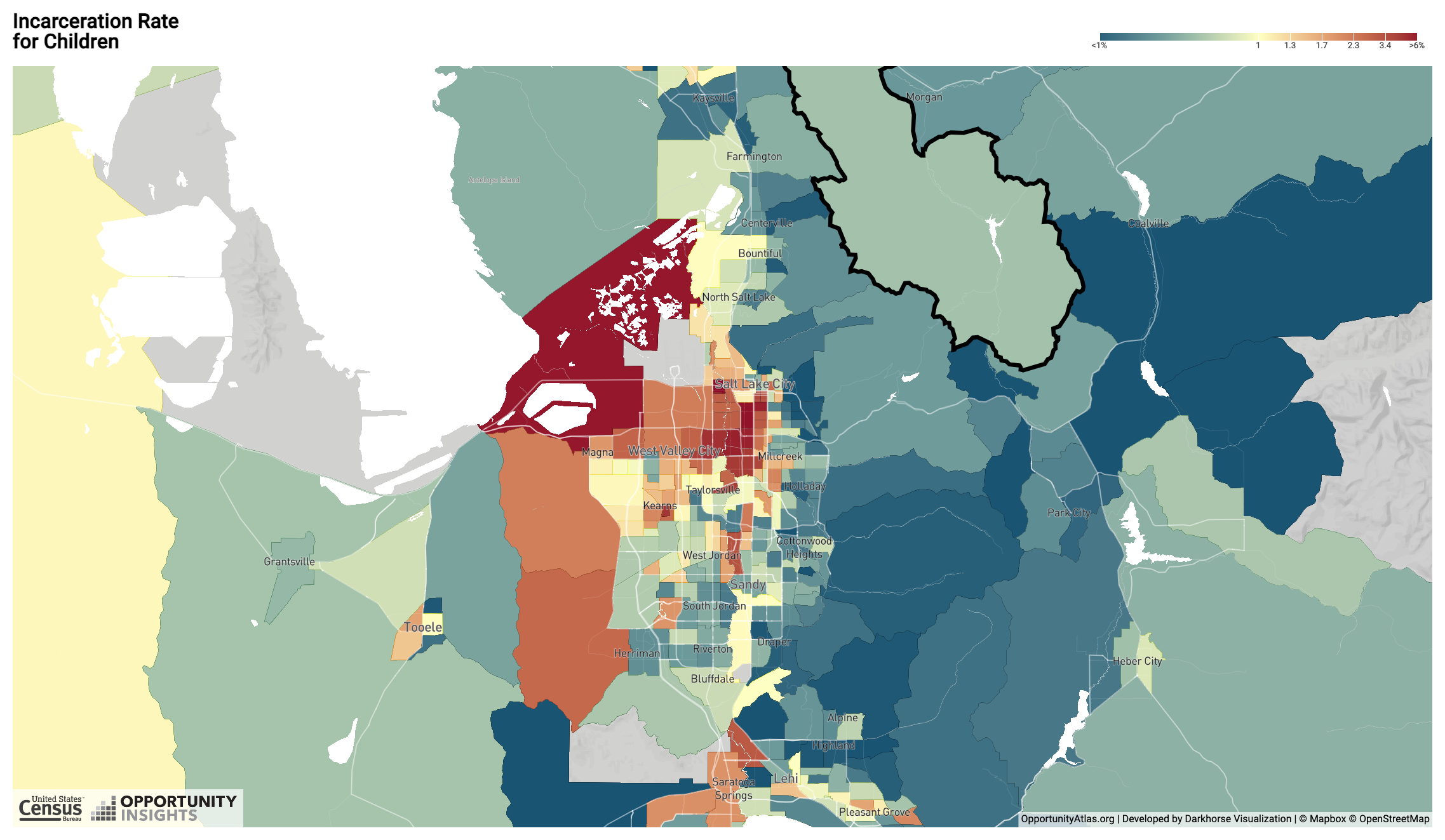
Opportunity Atlas — incarceration rate by childhood neighborhood in Salt Lake County
🔍 Click to zoom

This map shows the fraction of children born 1978-1983 who grew up in each Salt Lake County neighborhood and were incarcerated on April 1, 2010 — when they were 27 to 32 years old.

These are the outcomes of the previous generation. The darkest red tracts — concentrated on the west side — are the same neighborhoods our care desert maps identify today. The community conditions that produced those outcomes have not changed.

31%
higher adult earnings
if moved before age 13
lower incarceration
higher college attendance
$16
return per $1 invested
in early childhood (Perry)

Earlier intervention = larger returns. Chetty's MTO experiment proved that moving before age 13 changed adult outcomes. Moving as an adolescent had slightly negative impacts. The interception window is widest in early childhood.

▾ About the research

The Opportunity Atlas tracks 20.5 million children from the 1978-1983 birth cohorts using de-identified Census and IRS data. Incarceration = being in a correctional facility on April 1, 2010 (Census day). The MTO experiment (1994-98) randomly assigned 4,600 families housing vouchers to move from high-poverty public housing.

Chetty, Hendren & Katz (2016). AER → · Opportunity Atlas →

Education outcomes

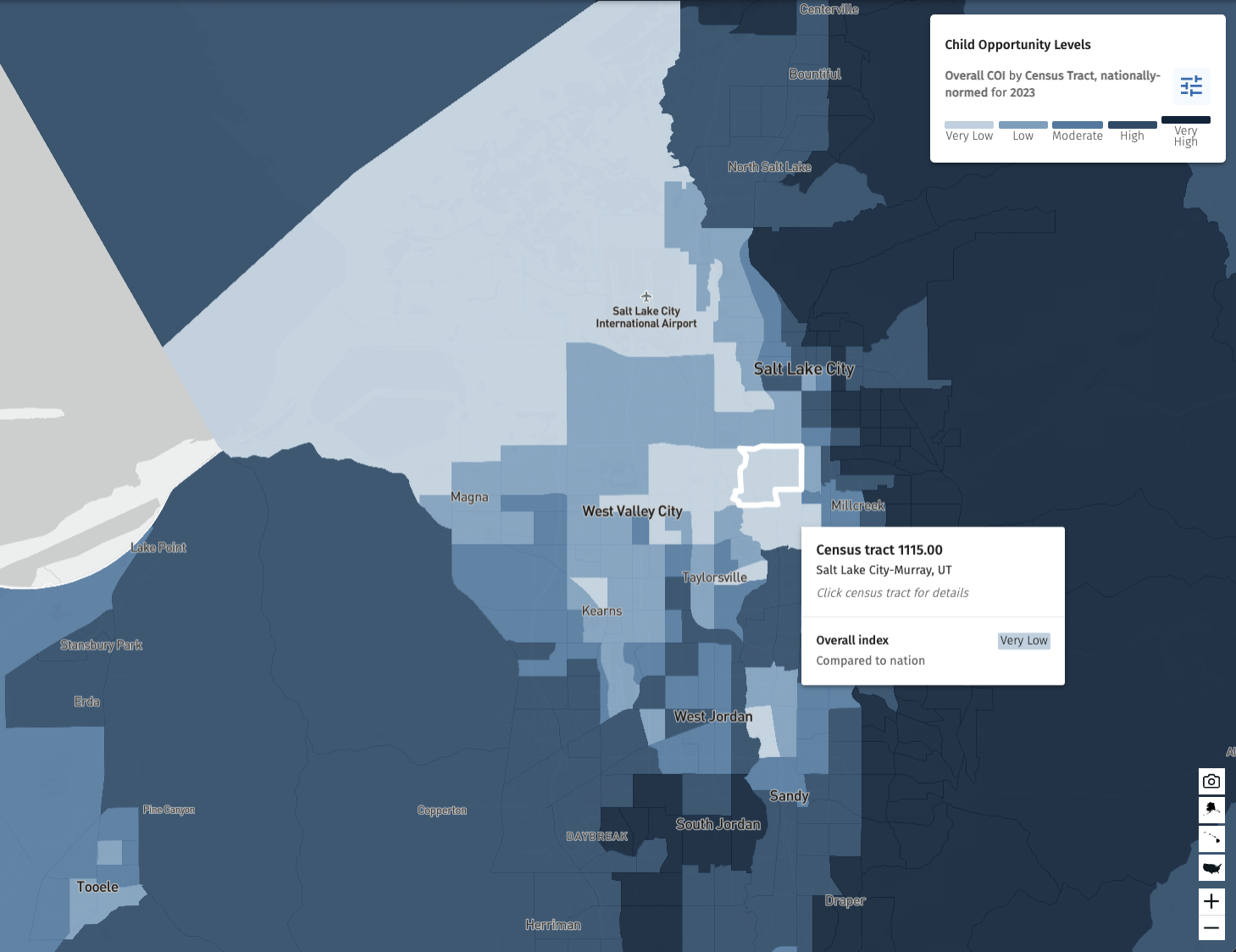
The same neighborhoods score lowest on child opportunity

Child Opportunity Index — Salt Lake County west-side tracts score Very Low on education domains
🔍 Click to zoom

Child Opportunity Index 3.0 · diversitydatakids.org

The Child Opportunity Index confirms the same pattern from the education side. The west-side tracts that show the highest incarceration rates on the Opportunity Atlas also score "Very Low" on:

Incarceration outcomes and educational outcomes are shaped by the same neighborhood conditions. The children in the darkest tracts on the incarceration map are also in the lowest-opportunity tracts on the education map.

8/100
Education domain overall
21/100
Early childhood education
10/100
Elementary education
-1
Reading and math test scores (below national average)
The convergence

Four pathways. Same neighborhoods. Same youth.

Every layer of evidence we've examined converges on the same census tracts. The spatial data, the causal research, the education outcomes, and the household burden all point to the same places.

🧠
ACEs pathway
Trauma → brain development → classroom behavior → discipline → justice contact
📍
Neighborhood effects
Place → opportunity → mobility → earnings → incarceration (Chetty)
📊
Child opportunity
Education access → school quality → test scores → future outcomes (COI)
👩‍👧
Household burden
Female-headed households → caregiving stress → fewer supports → increased referrals

These neighborhoods had limited access to protective factors for the previous generation. This still holds true for the current generation.

Place is not a backdrop. It is the mechanism.

2 The Mechanism

How structural conditions produce the behaviors the system responds to, and where the interception points are

skip to solutions →

Understanding the problem is necessary. But how do we balance accountability with prevention?

The balance

Public safety is paramount. So is reducing re-offense.

We acknowledge that accountability, including retribution, deterrence, and incarceration, is part of the response. But the majority of justice-involved youth will reenter the community. The question is: what type of response produces the best outcomes for public safety?

🔒

The incarceration reality

70-80%
re-arrested
within 2-3 years
$214K
per youth
per year

Juvenile incarceration causally decreases high school completion and increases adult incarceration, including for violent crimes. The system is expensive and produces high recidivism.

📄 See the research (3 studies)
Aizer & Doyle (2015). QJE. Used random assignment of judges as an IV across 35,000 juvenile offenders over 10 years. Juvenile incarceration results in substantially lower HS completion and higher adult incarceration, including violent crimes.
Petrosino et al. (2010). Campbell Systematic Review. Meta-analysis of 29 RCTs. Traditional system processing slightly increases delinquency relative to diversion. Formal processing is no more effective than release and may be harmful.
Annie E. Casey Foundation (2020). 70-80% of incarcerated youth re-arrested within 2-3 years. Exposed to violence, gang recruitment, and peer contagion effects inside facilities.

Swift and certain responses

40%
recidivism ↓
DNA databases (Doleac)
25%
lower recidivism
community sanctions

Swift, certain, and proportionate responses produce better deterrence than severe but delayed punishment. People most at risk are not making long-term calculations about future penalties.

📄 See the research (3 studies)
Doleac (2025). "Rethinking Punishment." A high certainty of immediate accountability deters more effectively than a small chance of severe punishment. DNA database expansion produced 40% recidivism reduction through increased certainty of identification.
Shem-Tov, Raphael & Skog (2024). Econometrica. Restorative justice conferencing (Make-it-Right, San Francisco) reduced felony reconviction. Diversion from formal processing reduces recidivism.
Wilson & Hoge (2013). Criminal Justice & Behavior. Meta-analysis of youth diversion programs. Diversion consistently reduces recidivism compared to traditional processing, especially for low-risk youth.

The question isn't whether to hold youth accountable. It's how to hold them accountable in ways that also promote public safety.

9 in 10
low-risk court-referred youth do not reoffend
regardless of intervention

The system's resources should concentrate on high-risk youth. The community's resources should concentrate on prevention in the neighborhoods producing the most contact.

Vincent, Skeem & Weber (2024). Youth Reoffending: Prevalence and Predictive Risk Factors in Two States. UMass Chan / CSG Justice Center · Full PDF →

The developmental pathway

Adverse childhood experiences are situated in place. Place can amplify the risk.

ACEs interact with community conditions in a dose-response pattern — each additional adverse experience increases the odds of justice involvement. But the pathway is not inevitable. We're not talking about throwing lifelines to youth already in the river. We're talking about building the fences upstream. Click each stage to see where protective factors can redirect the trajectory. See the structural conditions beneath this pathway →

Structural
conditions
upstream root causes
ACEs
1.68×
per ACE point
Brain development
Prefrontal cortex
Amygdala
Classroom behavior
Undiagnosed
needs
School discipline
Suspension
LE referral
Justice contact

Click any stage to see details and the interception point

Upstream structural conditions

Poverty, housing instability, food insecurity, community violence, parental mental health and substance use, and incarceration in the family. These upstream drivers produce the chronic stress that becomes ACEs. Scarcity narrows cognitive bandwidth, reducing working memory, planning, and impulse control.

Mani, Mullainathan, Shafir (2013). Science →

Without upstream reform, midstream interventions cannot break the cycle

Restorative justice can reduce suspensions and improve relationships, but it cannot eliminate poverty, stabilize housing, or change neighborhood conditions. Lasting change requires upstream supports (housing, income, healthcare access) combined with midstream interventions (counselors, youth programs, credible messengers).

The strongest results come from layered approaches: economic stability + family support + school climate + mental health services + diversion.

Adverse Childhood Experiences

Justice-involved youth are 12× more likely to have experienced at least one adverse or traumatic experience vs non-system peers. Each additional ACE increases the odds of justice contact by 1.68×. More ACEs = younger age of first offense.

Baglivio et al. (2021). Pediatrics →

Intergenerational transmission

Parents with 4+ ACEs have children with 3.22× higher odds of conviction before age 26. The cycle is intergenerational — and geographic. The same neighborhoods produce ACEs across generations.

Merrick et al. (2023). JAMA Network Open →

How trauma alters the developing brain

Early childhood trauma alters two critical brain regions: the prefrontal cortex (impulse control, decision-making, planning) and the amygdala (threat detection, emotional regulation, fear response). The brain adapts to a threatening environment by remaining in a heightened state of alertness, which can look like "behavioral problems" in a classroom setting.

Interception point: 🩺 Pediatric screening can identify trauma-related developmental delays before school entry — routing children toward treatment instead of discipline.

Early Childhood Trauma Impact on Brain Development →

Undiagnosed conditions drive classroom behavior

Children with neurodevelopmental disorders are at 5× higher risk for mental, emotional, and behavioral problems (AAP 2025). ADHD (3.1× justice involvement), undiagnosed ASD (misidentified as defiance), and dyslexia (academic failure → disengagement) all present as "behavioral problems" when unscreened.

Interception point: 🩺 Expanding screening beyond anxiety/depression/SI to include ADHD, autism, and learning disabilities.

AAP (2025). Screening for MEB problems →

When schools respond with discipline instead of support

When a child with undiagnosed ADHD acts out, the counselor is unavailable, and the officer is right there. The behavioral incident becomes a law enforcement contact.

Interception point: 🏫 School counselors route incidents toward support instead of enforcement. Schools with counselors and no LE have the lowest absenteeism.

Justice contact is the narrowest window — and the most expensive

43% of court-referred youth are low risk — 9 in 10 do not reoffend (Vincent, Skeem & Weber, 2024). Juvenile incarceration causes large decreases in high school completion and large increases in adult incarceration (Doyle 2007). By this point, every upstream window was missed.

Interception point: 🏘️ Community organizations provide structured alternatives as the last upstream window before system involvement. Every 10 orgs per 100K reduces murder by 9%.

Mental health alone doesn't reduce reoffending; youth need risk-reduction services at sufficient dosage.

Before programs · Before systems

What youth actually need — and what the system often misses

The programs that succeed are the ones that address these four needs directly. Click each to learn more.

🏠

Basic needs met at home

Stability before everything else

tap to learn more ▾
🤝

A stable person in their life

Continuity of care, not caseload

tap to learn more ▾
🔗

Someone who makes the connection

The relationship is the delivery mechanism

tap to learn more ▾
👨‍👩‍👧

Families need trust with the system

Institutional distrust is earned, not irrational

tap to learn more ▾

Often what youth struggle with most is having their basic needs met in their homes: stable housing, food security, a safe place to sleep, adults who are present and not in crisis. When these foundations are missing, no school program or youth organization can fully compensate. A child who didn't eat dinner, who slept on a couch in a crowded apartment, who watched a parent get arrested — that child arrives at school in survival mode. Our upstream structural conditions analysis measures exactly where these deficits concentrate, and our care desert maps show where the services that could stabilize families are absent.

Youth need continuity of care from a trusted adult who is there before system contact, not after. A probation officer arrives at the final stage and acts as a social worker when the system has already intervened. But a mentor, a teacher, a community member who knows the youth and stays through transitions — that is the protective factor research consistently identifies as the most important. This is what Friends of the Children provides for 12+ years: a paid, professional mentor starting at age 4. The Friend doesn't disappear when funding cycles end or when the youth moves schools. They stay. That consistency is what makes the difference between a program and a relationship.

Resources exist, but youth don't find them on their own. Someone in their life needs to recognize what the youth needs, know what resources are available, and make that connection through a supportive, trusting relationship. This is the bridge function that family liaisons at Promise South Salt Lake, Friends at Friends of the Children, and credible messengers in Cure Violence all perform. The resource itself matters less than the relationship that delivers it. A flyer on a bulletin board doesn't change behavior. A person who says "I know what you need, and I'm going to take you there" does.

Many households have already been affected by the justice system. Parents who were incarcerated, siblings who were removed, families who were surveilled. These families carry institutional distrust that makes them unlikely to seek services voluntarily, opt into screenings, or engage with programs perceived as connected to enforcement. This distrust is not irrational — it's learned from experience. Effective interventions must be embedded in community organizations that families already trust, not delivered through the institutions they have learned to avoid. This is why culturally specific organizations matter, why community research walks matter, and why the "who delivers it" matters as much as "what is delivered."

The through-line: Every effective program we highlight in this presentation, from Promise South Salt Lake to Friends of the Children to Homeboy Industries, succeeds because it meets these four needs: it addresses basic stability, provides a consistent trusted person, connects youth to resources through relationships rather than referrals, and earns the trust of families who have reason not to trust systems. The care desert maps identify where all four needs are most acute.

Framework alignment: These needs align with the Utah State Board of Education's Protective Factor Framework — Concrete Supports, Social Connections, Resilience, and Cognitive/Social/Emotional Competence. When programs like PSSL provide structured programming, they activate multiple protective factors simultaneously. Protective factors don't stand alone; building one strengthens the others.

The framework

At each stage of development, the right protective factor can redirect a trajectory.

The further downstream we wait, the narrower the window and the higher the cost. Our spatial analysis measures each window at the neighborhood level.

🩺
Window 1

Early development

Early investment in care and screening catches developmental issues before they become school behavioral problems and justice contact.

3.1×
ADHD → justice involvement. The widest window.
▾ See the research

AAP (2025): Neurodevelopmental disorders → 5× higher behavioral risk. Early screening redirects to treatment.

Perry Preschool (RCT, 40-yr): 36% fewer arrests by age 40. $16 return/dollar, 88% from crime savings.

Nurse-Family Partnership (3 RCTs): 56% fewer arrests at age 15. 90K violent crimes were prevented with nurse home visits during pregnancy and the first two years.

Chicago Child-Parent Centers: 29% reduction in juvenile arrests. $7 return per dollar with preschool + parent engagement in high-poverty neighborhoods.

Heckman (2010): Every dollar spent on early childhood intervention returns $7-16 in reduced crime, health costs, and increased productivity. Returns decline with age: earliest investment = highest return.

Head Start REDI Preschool (RCT): Preschool social-emotional supports → sustained fewer behavior problems in high school.

🏫
Window 2

School environment

Counselors and restorative practices route behavioral incidents toward support rather than enforcement. Every child passes through this window.

16%
suspension drop (RAND RCT, Pittsburgh)
▾ See the research

Carrell & Hoekstra (2014): Lower counselor ratios causally reduce disciplinary problems and improve achievement (regression discontinuity, Florida).

RAND PERC RCT (Augustine 2018): 16% suspension drop across 44 Pittsburgh schools through restorative practices.

Restorative Justice meta-analysis (394K students): School interventions significantly reduce exclusion (p < 0.001). More effective for suspensions than expulsions.

Make-it-Right RCT (Shem-Tov 2024): RJ conferencing → reoffense rates ~⅓ lower than traditional court processing.

School teletherapy (2025, preprint): Reduced disciplinary actions and improved attendance in socioeconomically vulnerable youth.

🏘️
Window 3

Community safety net

Youth organizations, mentoring, and crisis intervention. The last upstream window before justice system contact.

9%
murder reduction per 10 orgs / 100K (Sharkey)
▾ See the research

Sharkey et al. (2017, ASR): IV design, 264 cities, 20 yrs. +10 orgs/100K → 9% murder. Cumulative long-term effects of 12% reduction in homicide, 10% in violent crime, and 7% in property crime.

Sharkey (2023, Vital City): NYC precinct-level replication confirmed causal relationship at local level.

Lavecchia et al. (2024): Pathways to Education in Toronto substantially reduced youth crime. Cross-national confirmation.

Branas et al. (2018, PNAS): Greening vacant lots → 29% gun violence reduction (cluster RCT, Philadelphia).

Urban Institute (2022): "Community quarterback" model — community org at center of violence reduction is most effective.

These windows don't fail independently. The neighborhoods where all three are weakest are the same neighborhoods producing the highest juvenile court referral rates, which are the same tracts you just saw on the map.

⚠️ Emerging risk

On top of these structural conditions, social media has accelerated recruitment and escalation

Online provocation

"Internet banging" — public gang taunting on platforms — normalizes violence and creates status hierarchies. Recruitment now extends beyond neighborhood boundaries. Rivalries are performed publicly.

Patton et al. (2022) → · van Hellemont & Densley (2020) →

Real-world violence

Digital disputes escalate to physical harm. The victim-offender overlap is spatially concentrated — it occurs most in neighborhoods with the weakest institutional supports, where trauma goes unaddressed and cycles of retaliation are unchecked.

Victim-offender overlap (2025) → · Neighborhood context →

But protective factors moderate this pathway

Youth with strong prosocial connections, adult mentorship, and structured activities are substantially more resilient to online recruitment. The neighborhoods with the fewest protective factors are where online radicalization poses the greatest risk. Social media accelerates risk, but it doesn't create it. The underlying vulnerability is a community-level condition that our care ecology maps measure.

The U.S. Surgeon General's 2023 Advisory found that social isolation carries health risks equivalent to smoking 15 cigarettes per day and is twice as harmful as obesity. The care desert tracts we've identified are also social isolation deserts.

Risk factors for gang joining: meta-analysis → · 2025 youth gang involvement study →

3 The Response

What works, what's already working locally, and how to deploy interventions where the data shows the greatest return

In Salt Lake County, these programs need to reach the communities where the need is greatest — and where they are currently most absent.

🏆 Local evidence

It's already working here. In Salt Lake County.

The national evidence base is compelling, but Salt Lake County has its own proof of concept. Afterschool and summer programs are functioning as both preventive interventions and diversion mechanisms, engaging youth in prosocial activities during the hours when juvenile crime peaks.

2–6 PM
The prime time for
juvenile crime in Utah

25% of all juvenile crime on school days occurs between 2 and 6 PM, the hours immediately after school when parents are often unavailable. Afterschool programs fill this gap with structured, supervised environments that build protective factors and redirect behavior.

Fight Crime: Invest in Kids / Council for a Strong America →

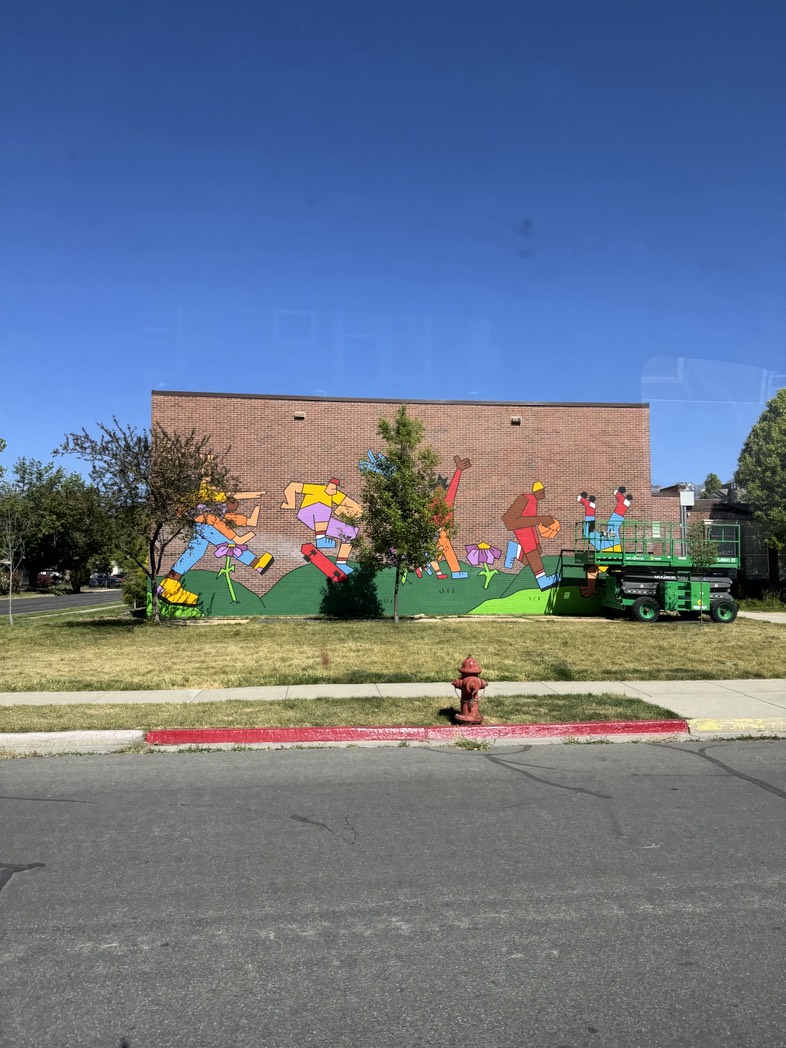
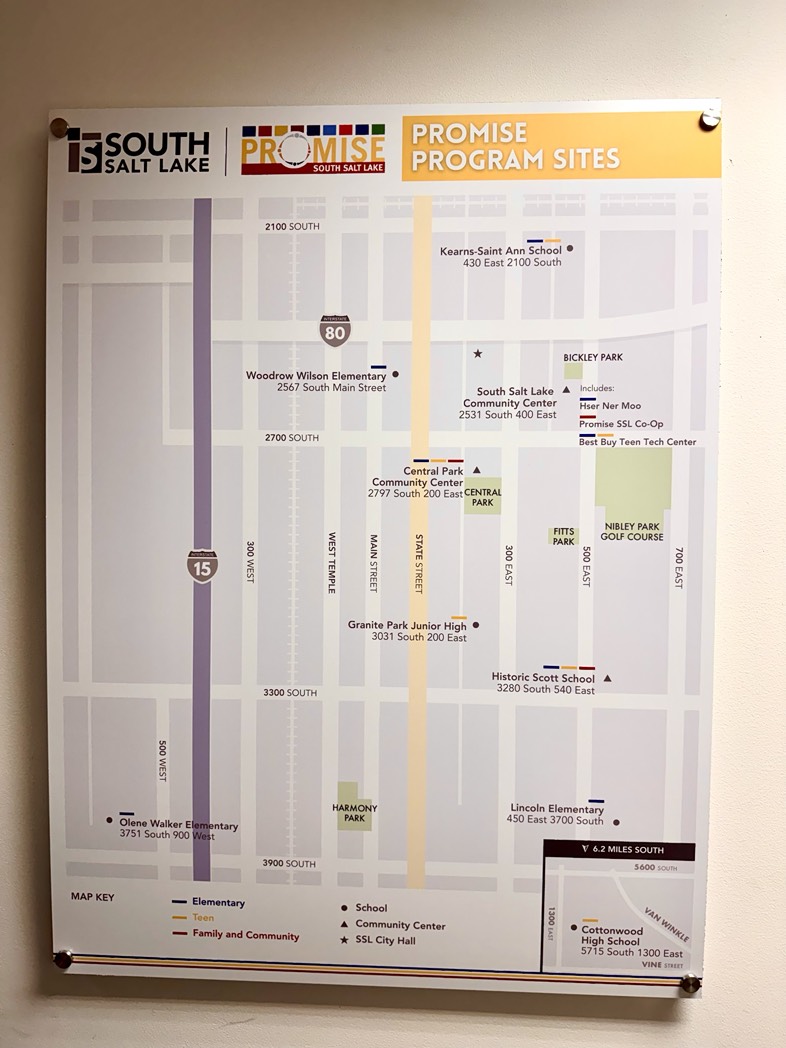
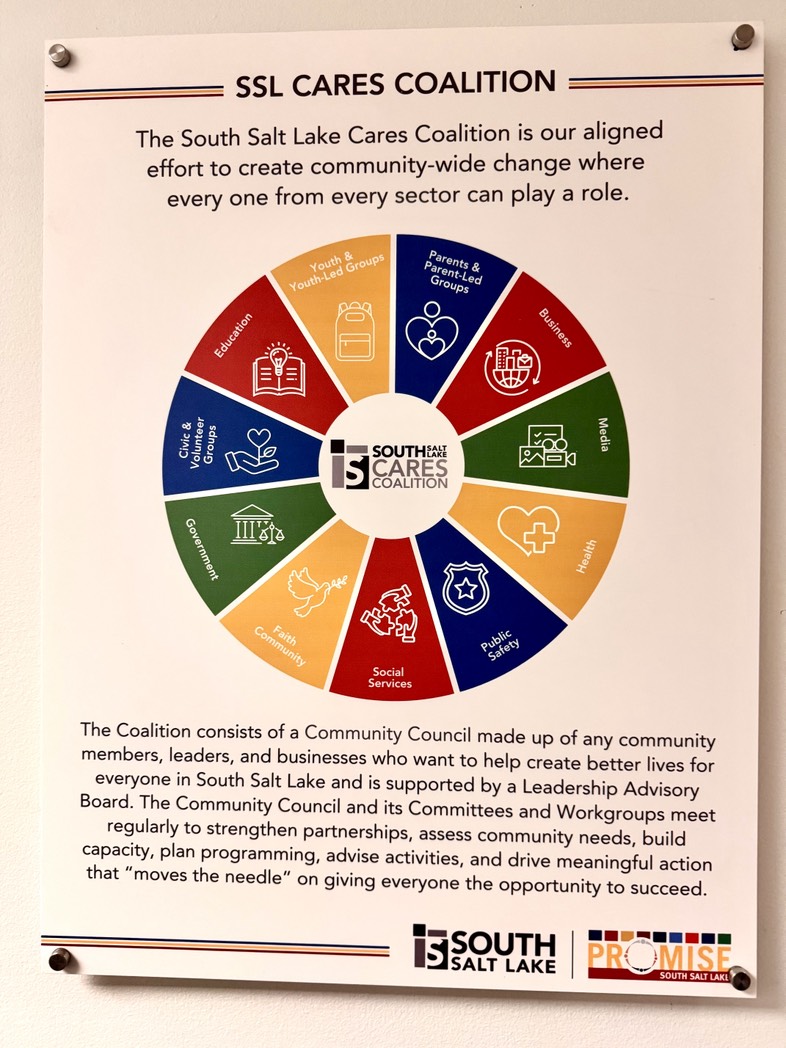
Promise South Salt Lake Promise South Salt Lake Promise South Salt Lake Promise South Salt Lake
📍 South Salt Lake
Promise South Salt Lake
🌟
Featured · Citywide afterschool system

Promise South Salt Lake

14 community and school-based sites serving 2,700 students in grades K-12 through partnerships with 110 youth-focused groups.

📉
71%
decline in juvenile arrests
overall (2010-2019)
🕐
67%
reduction in juvenile arrests
during 3-6 PM on school days
🛡️
25.6% → 7.2%
gang involvement risk
for 8th graders since 2007
📚
74%
of elementary teachers
reported improved behavior
💪
50%
increase in peer pressure
resistance skills
🔍 How it works: the PSSL daily model
Click to expand ▾

PSSL programs run five days a week, 3-6 PM across all 14 sites. Many students have limited English proficiency, so academic programming focuses on grade-level gains in English language arts and math. On Fridays, programs devote more time to enrichment activities.

🍎
3:00 PM
Snack
📖
3:15 – 4:15
Academic Hour
Tutoring, homework, ELL support
🍽️
4:15 PM
Dinner
🎨
4:30 – 6:00
Enrichment
STEM · Art · Recreation · SEL
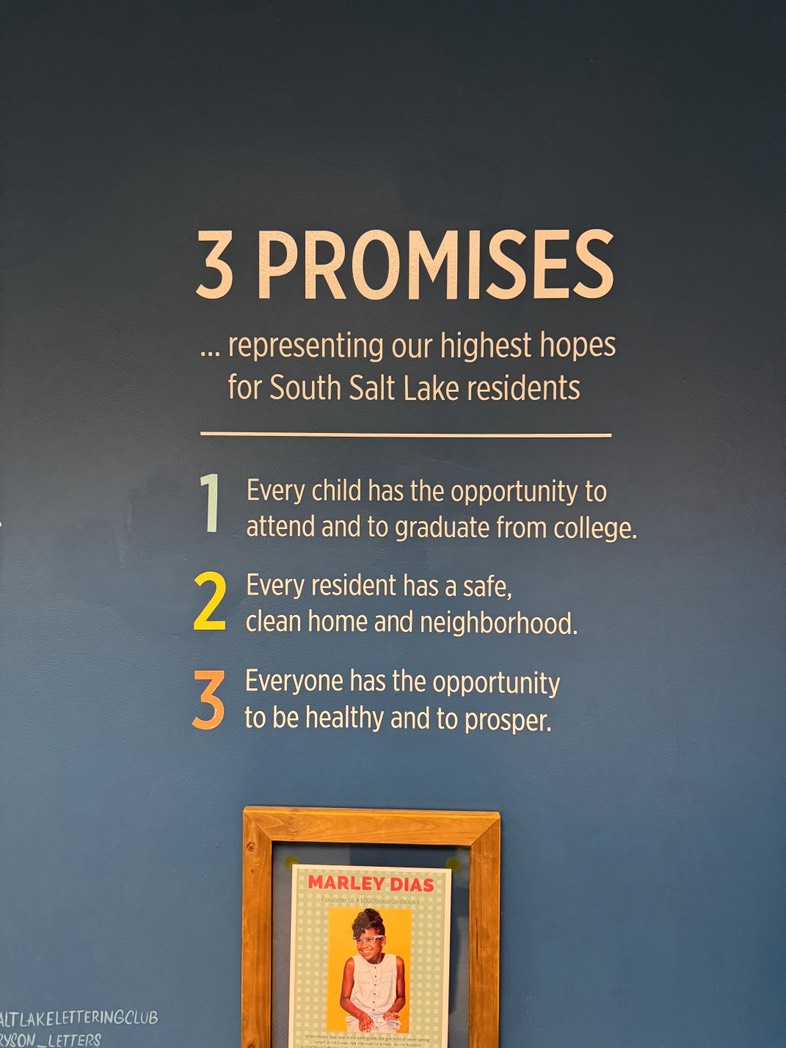
The three pillars
🎓
College readiness
Academic support, tutoring, ELL, grade-level gains
🛡️
Safety
Prevention programming, SEL, police mentors, peer pressure skills
❤️
Health & prosperity
Family liaisons, health clinics, food pantries, workforce training

Schools, social workers, and law enforcement refer students to PSSL for academic supports as well as prevention programming that reduces risk factors for youth (such as involvement in gang activity) and increases protective factors (such as smart decision-making and understanding how to deal with peer pressure). PSSL operates across a prevention-to-diversion spectrum:

The prevention-to-diversion spectrum
🌱
Universal
All youth. Build protective factors, safe environments, caring mentors.
🎯
Targeted
At-risk youth. Referrals from schools, social workers, LE, courts.
🔄
Diversion
Alternative to detention. Address root causes, prevent reoffending.

🤝 LE partnership: South Salt Lake Police officers serve as mentors to youth in the programs and participate in community events to strengthen police-community relations. PSSL offers retreats focused on healthy decision-making. Family liaisons employed across all sites connect students' families to health clinics, food pantries, and workforce training.

📊 Social-emotional learning: SEL is embedded across all sites. A 2020 report found that teaching social-emotion skills produced measurable improvements in classroom behavior, conflict resolution, and student engagement. 66% of elementary and 61% of middle/high school teachers noted improvement in grades.

Afterschool Alliance: PSSL Juvenile Justice Spotlight → · Fight Crime: Invest in Kids — Utah → · SSL Journal: SEL Success → · ERIC: Afterschool & Juvenile Justice → · KSL: Local Youth Initiatives →
The model Inspired by the Harlem Children's Zone
Click to expand ▾

Promise South Salt Lake follows the place-based, whole-community approach pioneered by the Harlem Children's Zone (HCZ). Founded by Geoffrey Canada in the 1990s, HCZ operates a "conveyor belt" of cradle-to-college programs across a 97-block area of Central Harlem, providing continuous support from Baby College through college graduation.

The HCZ model has been rigorously evaluated. Dobbie & Fryer (2011) used lottery-based RCT methods and found that students attending the Promise Academy scored 0.229 standard deviations higher per year in math. A follow-up study (Dobbie & Fryer, 2015) found that attending Promise Academy increased the probability of enrolling in college by 24.2 percentage points, an 84% increase. Students also showed reduced risky behaviors including teen pregnancy and incarceration.

The federal government recognized the HCZ approach by launching the Promise Neighborhoods Initiative, which has funded over 60 communities nationwide to replicate the model. The core insight that both HCZ and PSSL share is that individual programs are not enough. Children need a web of interlocking supports embedded in their neighborhood, so that no matter which door they walk through, they're connected to the full continuum of care.

Dobbie & Fryer (2011, 2015). Harvard/NBER → · What Works Clearinghouse: HCZ → · Harlem Children's Zone →

🗺️ Why PSSL matters for our framework: Promise South Salt Lake is a working example of what the care desert maps identify as missing. It fills the 2-6 PM gap with structured programming, builds protective factors through SEL and mentoring, provides diversion pathways that keep youth out of the justice system, and connects families to upstream services. The 71% decline in juvenile arrests and the drop in gang involvement risk from 25.6% to 7.2% demonstrate that place-based, community-wide afterschool systems produce the outcomes our spatial analysis predicts. The question is where to replicate this model next, and the care desert maps answer that question.

Continuity of care

Friends of the Children — Utah

The first and only long-term professional mentoring program in the country. A paid, professional mentor called a "Friend" commits for 12+ years, from kindergarten through high school graduation. Each Friend works with 8-10 youth, spending 14-16 intentional hours per month with each child. This is not volunteer mentoring. It's a full-time job.

83%
graduate high school
50% of parents were dropouts
93%
avoid juvenile justice
60% have incarcerated parent
98%
avoid early parenting
85% born to teen parent

The model was founded on research showing that the single most important factor in overcoming childhood adversity is a long-term, nurturing relationship with a consistent and caring adult. By the time Friends of the Children meets them, children in the program have experienced an average of four ACEs.

A probation officer arrives at the final stage. A Friend arrives at age 4. The Friend recognizes what the youth needs, makes the connection to resources, and stays through the entire developmental pathway. This is the stable, trusted relationship that can intercept the ACEs-to-justice trajectory before it begins.

Friends of the Children — Utah → · National Mentoring Resource Center → · Mental Health Impact →
What we're doing

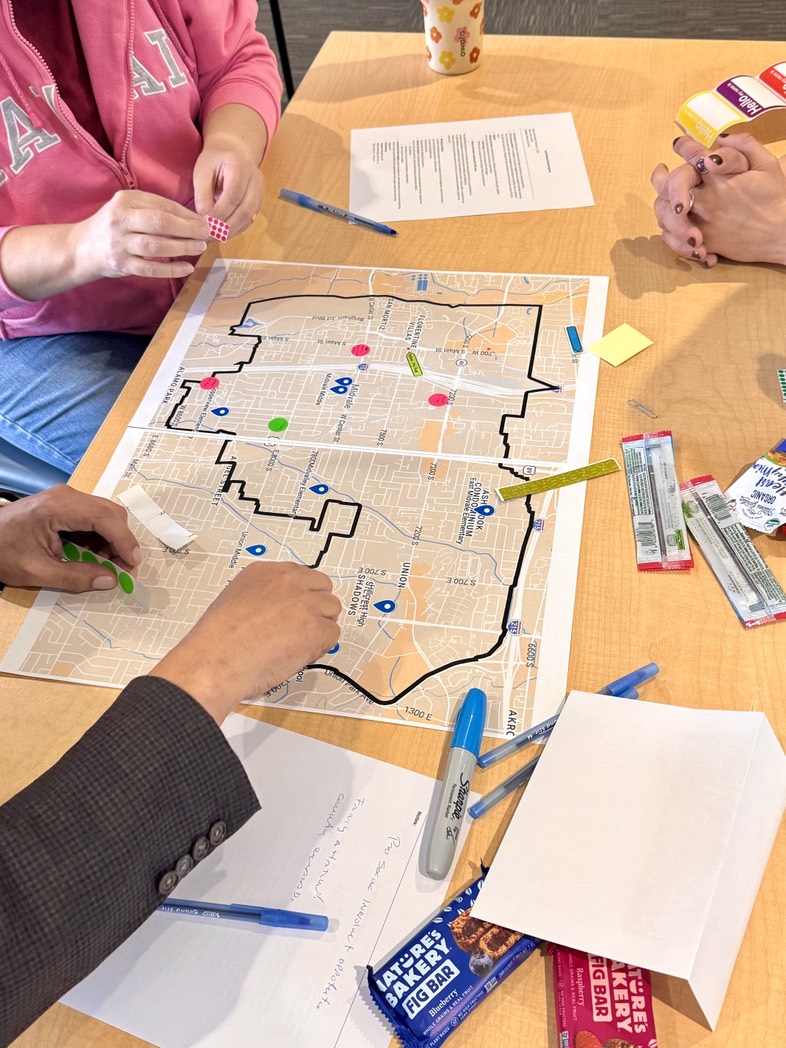
Community research walks: bringing the data to the neighborhoods

The maps identify where care deserts exist. But data alone doesn't produce change. We're taking the spatial analysis directly into the neighborhoods it describes, walking the streets with residents, service providers, and local leaders to ground-truth the data and co-produce intervention strategies.

Modeled after the Newark Public Safety Collaborative

Data-Informed Community Engagement (DICE)

The DICE model, developed by the Newark Public Safety Collaborative with BJA support, partners university researchers with community-based organizations to translate spatial crime data into resident-led safety strategies. Instead of top-down enforcement, communities become co-producers of public safety.

We're adapting this model for Utah. Our community research walks bring the care desert maps, school discipline data, and neighborhood risk profiles directly into the tracts they describe. Residents identify what the data misses, validate what it captures, and shape the intervention priorities.

🚶‍♂️
Walking
the data
Community research walk
📍

Midvale · Ogden

Salt Lake County & Weber County · Care desert tracts

Walking the care desert tracts with community partners to identify service gaps the maps highlight, validate findings with residents who experience these conditions daily, and connect spatial evidence to on-the-ground intervention design. In partnership with local coalitions, county government, CCJJ is engaging educators, families, and community stakeholders through focus groups, participatory mapping, and community research walks to collect resident-informed insights on community safety and youth well-being.

The principle: Spatial analysis identifies the neighborhoods. Community engagement ensures the interventions reflect what residents actually need. Data without community voice produces policy for people. Data with community voice produces policy with people.

Newark DICE Model →

The maps show where. The evidence shows why. Now: what to do about it.

Five steps from spatial analysis to targeted protective factor investment

The policy tool

Place-based intervention matching

The interception window framework is an allocation tool. It translates spatial analysis into targeted action in five steps. Click each step to expand.

1
Identify highest-risk areas
Juvenile referral and adult corrections geographic overlap

Using spatial analysis of juvenile court referral data and adult correctional supervision records, identify the census tracts where both systems concentrate. These are the neighborhoods where the intergenerational cycle is most active and where upstream investment has the highest return.

2
Diagnose the weakest interception window
Which care ecology domain is failing in each neighborhood?
🩺
Early development
Pediatric screening
🏫
School environment
Counselors, practices
🏘️
Community safety net
Youth orgs, mentoring
3
Map the service gap
What specific protective factor is missing or inaccessible?

For each high-risk tract, the care ecology maps identify exactly which services are absent: matched deserts (the service doesn't exist nearby), mobility-constrained deserts (exists but unreachable by transit for youth under 16), and service-type mismatches (services exist but don't match the need).

4
Match the evidence-based intervention
G.R.E.A.T., summer employment, counselors, screening

Each gap maps to a specific intervention: pediatric gap → telehealth screening; counselor gap → ASCA 250:1 staffing; youth program gap → G.R.E.A.T. + summer employment; community org gap → nonprofit placement in care deserts. The key insight from Vincent et al.: having services nearby isn't enough — they must match the need.

5
Deploy where the return is highest
Care deserts, not places already well-served

The marginal return on investment is highest in care deserts. Deploying a school counselor in a building already at 250:1 has modest impact. Deploying one in a building at 650:1 in a care desert tract transforms the interception window for every student. Instead of distributing resources uniformly, concentrate investment where risk is highest, protective factors are most absent, and evidence-based interventions have the largest effect sizes.

Open full interactive framework →

What works — and why

Programs that succeed because they honor what youth actually need

Los Angeles · Father Gregory Boyle, S.J.

Homeboy Industries

"Nothing stops a bullet like a job."

Paid work-therapy through social enterprises. Mental health, tattoo removal, case management. Five identity-replacing services: jobs, new identity, family, sobriety, and plans for a future.

National Gang Center: Homeboy Industries →

70%
non-rearrest
at 2 years
10K+
served annually
44%
arrest ↓
School-based CBT

Becoming a Man (BAM)

Teaches youth to slow automatic responses. 36% graduation increase. UChicago Crime Lab RCT.

Why it works: Cognitive behavioral therapy delivered in high schools during the school day. Teaches youth to distinguish between automatic responses appropriate for dangerous neighborhoods and those appropriate for school settings. Addresses the brain development stage of the ACEs pathway directly.

Large-scale RCT across Chicago public schools. 44% reduction in violent crime arrests, 36% increase in high school graduation. UChicago Crime Lab →

30%
incarc. ↓
Relentless outreach

ROCA

Targets highest-risk young men (18-24). Doesn't wait for youth to show up. Pay-for-success model.

Why it works: Relentless, persistent outreach combined with CBT for the hardest-to-reach young men. Addresses the "future orientation" gang incentive directly by offering a credible alternative trajectory when no mainstream institution is reaching out. Pay-for-success financing ties funding to actual incarceration reduction.

Boston and Baltimore. 30% reduction in incarceration days. ROCA →

Sig.
gun viol. ↓
Violence interruption

Cure Violence

Credible messengers with lived experience. Independent from law enforcement. Treats violence as contagion.

Why it works: Meets youth culturally, geographically, and experientially. Uses the epidemiological model: detect, interrupt, change norms. Credible messengers have the trust that institutional actors lack. Addresses the security provision incentive by offering protection through de-escalation rather than enforcement.

Significant gun violence reductions in NYC. Implementation review (2025) →

50%
charges ↓
Family therapy

FFT-Gangs

Family-based therapeutic intervention for justice-involved youth. Addresses family domain risk factors directly.

Why it works: Targets the family domain from the Mallion & Wood risk factor framework. When family social capital is depleted, youth seek belonging elsewhere. FFT-G rebuilds family functioning as the protective factor. Philadelphia RCT: drug charges cut from 22% to 11%, adjudications from 38% to 23%.

Currently in second RCT in Denver (Pyrooz et al.). Denver GRID is the first preregistered CVIP trial. Pyrooz et al. (2025). Criminology →

Federal
evaluated
Multi-component

OJJDP Gang Model + Good Lives Model

Only federally evaluated comprehensive approach. GLM: "build a life worth living" rather than "stop doing bad things."

Why it works: Combines mobilization, intervention, opportunity provision, suppression, and organizational change. Significant reductions in three sites. The Good Lives Model reframes intervention around what youth need (identity, connection, purpose, safety) rather than what they should avoid. Maps directly onto the six gang incentive domains.

OJJDP model → · GLM extension →

9/14
studies +
Gender-transformative

Equimundo — Manhood 2.0

Engages young men 15-24 in reflecting on harmful gender norms. Two active US RCTs. Program H adapted across 32+ countries.

Why it works: Addresses the identity and status acquisition incentive. When harmful masculinity norms define status, gangs become the arena for performing manhood. Equimundo offers alternative masculinity frameworks. Bandebereho 6-year RCT showed sustained IPV reduction, breaking intergenerational ACEs transmission.

9 of 14 studies show attitude change. Manhood 2.0 →

Click any program to see why it works and the evidence base

Evidence-based protective factors

The evidence base, organized by interception window

Each window maps to a set of interventions with rigorous evidence. Earlier windows produce higher returns. Click any intervention to see the evidence and how it connects to our spatial analysis.

$16
return per $1

The highest return on investment in the entire pipeline. Every dollar spent on early childhood intervention returns $7-16 in reduced crime, health costs, and increased productivity. Returns decline with age (Heckman 2010).

Maps to: Pediatric Provider Access Map

36%
arrest ↓
RCTPerry Preschool

40-year follow-up. 36% fewer arrests by age 40. $16 return per dollar, 88% from crime savings.

The gold standard of early childhood intervention evidence. Random assignment of 123 African American children (ages 3-4) to high-quality preschool vs. control. At age 40: 36% fewer arrests, higher earnings, more home ownership. The $16 return per dollar is driven primarily by reduced criminal justice costs. ROI: $16.14 per $1 invested (Schweinhart et al., 2005)

56%
arrest ↓
3 RCTsNurse-Family Partnership

56% fewer arrests at age 15. 90K violent crimes prevented nationally. Home visiting for first-time mothers.

Three independent RCTs (Elmira, Memphis, Denver). Nurse home visits during pregnancy and first two years. Reduces child abuse, improves maternal health, and produces lasting effects on criminal behavior. Utah has NFP slots but they don't reach the care desert tracts where refugee families resettle. ROI: $5.70 per $1 invested (WSIPP)

29%
arrest ↓
Quasi-exp.Chicago Child-Parent Centers

29% juvenile arrest reduction. $7 return per dollar. Preschool + parent engagement in high-poverty neighborhoods.

Longitudinal study of 1,539 children in Chicago. Combines half-day preschool with parent involvement and school-age follow-up. The parent engagement component is critical for refugee families who may distrust institutions. ROI: $7.10 per $1 invested (Reynolds et al., 2011)

risk
ClinicalPediatric Developmental Screening

Neurodevelopmental disorders → 5× higher behavioral risk. Early screening is a critical prevention window.

AAP (2025) documents that children with neurodevelopmental disorders are at 5× higher risk for mental, emotional, and behavioral problems. Early screening redirects toward treatment instead of discipline. Current SLC screening is opt-in, English-only, and excludes ADHD, autism, and learning disabilities. 74% of SLC tracts have no local pediatrician to conduct these screenings. AAP (2025) →

The pattern across all three windows: Every intervention with rigorous evidence is place-deployable. The maps identify where. The evidence identifies what. The framework matches intervention to gap. Earlier windows produce higher returns, but every window matters because the neighborhoods where all three are weakest are the same neighborhoods producing the highest justice contact rates.

But these windows rest on a foundation
Upstream · Root causes · Primary prevention

The structural conditions beneath the three windows

When these upstream conditions are unstable, they produce the ACEs, the undiagnosed needs, and the service gaps that the three windows are trying to intercept. Without addressing these root causes, midstream interventions alone cannot break the cycle.

🏠
Housing stability
Instability → chronic stress → ACEs
💵
Family income
CTC, EITC, cash transfers
🩺
Healthcare access
Medicaid behavioral health
🌱
Early childhood
Pre-K, NFP, home visiting
🏘️
Neighborhood
Built environment, safety

CTC = Child Tax Credit · EITC = Earned Income Tax Credit · NFP = Nurse-Family Partnership · Pre-K = Pre-Kindergarten

📄 The evidence for upstream investment — 4 studies
Click to expand ▾
Natural experiment

Cash transfers at birth → lasting effects on earnings

A $1,300 cash transfer in infancy (10% of income) increased young adult earnings by 1-2%, improved math and reading scores, and increased high school graduation rates.

Barr, Eggleston & Smith (2022). QJE →

Quasi-experimental

EITC in childhood → higher education & employment

An additional $1,000 in EITC exposure during ages 13-18 increased high school completion by 1.3%, college completion by 4.2%, and young adult earnings by 2.2%.

Bastian & Michelmore (2018). J. Labor Economics →

Review

Safety net programs → improved adult outcomes

Children exposed to SNAP, Medicaid, EITC, and housing programs in early childhood show improved health, higher earnings, reduced incarceration, and greater economic self-sufficiency.

Hoynes & Schanzenbach (2022). J. Economic Perspectives →

RCT

Medicaid expansion → reduced depression & financial strain

Random assignment of Medicaid access produced a 30% reduction in depression and near-elimination of catastrophic medical expenditures.

Finkelstein et al. (2012). QJE →

The pattern: Upstream investments in income, healthcare, and early childhood produce measurable, lasting improvements in education, employment, and justice outcomes. The effects are largest when they reach families during early childhood and in the neighborhoods with the fewest existing resources.

When both layers fail
Downstream · Last resort

When both layers fail, the system becomes the only response

Without upstream stability and midstream interception, behavioral incidents escalate through suspension, law enforcement referral, and court involvement. Incarceration does not reduce reoffending — 70-80% of incarcerated youth are re-arrested within 2-3 years.

⚖️
Justice system
contact
🔒
Incarceration
🔄
Cycle repeats
🗺️

Our spatial analysis measures both layers: the upstream conditions (poverty, housing, healthcare access, environmental burden) and the midstream gaps (service access, counselor ratios, nonprofit density). The care desert maps identify neighborhoods where both layers are failing simultaneously.

Return on investment

Prevention pays. Incarceration costs.

The fiscal case for upstream and midstream investment is overwhelming. The average annual cost of incarcerating a young person now exceeds what most communities spend on an entire year of upstream support for dozens of youth.

Annual cost of youth incarceration
$214,620
per youth per year
40 states exceed $100K. Some exceed $500K.

Youth.gov (OJJDP) → · JPI Sticker Shock 2020 →

vs
Annual cost of upstream supports
$5K–$25K
per youth per year
Community-based prevention & intervention

WSIPP Benefit-Cost → · Youth.gov Prevention →

$7–$10
saved per $1 invested in delinquency prevention

Primarily from reduced incarceration costs. WSIPP (2004) →

25%
lower recidivism with community-based sanctions vs incarceration

Community alternatives outperform confinement. Youth.gov →

70–80%
of incarcerated youth are re-arrested within 2-3 years

Incarceration doesn't reduce reoffending. Annie E. Casey →

The key policy lesson: The states with the most success moved money upstream, from punishment to prevention, from incarceration to investment. No single intervention is a silver bullet. Systems change + upstream investment = lasting impact. Our spatial analysis identifies exactly where those investments produce the highest marginal returns.

Explore the data

All spatial evidence is publicly available. Hover, toggle, search by district or county.

Nonprofit Infrastructure

Youth reach, community, treatment, safety, regional comparison

Open →

Pediatric Access

1,330 providers, county + tract views

Open →

School Discipline

Suspensions, LE referrals, counselor ratios, pipeline risk

Open →

SLCO Referral Study

Juvenile justice spatial analysis · Salt Lake County

Open →

Statewide Study

2025 Statewide Youth Geospatial Study

Open →

Adult Risk Drivers

Top 100 neighborhoods, primary factors

Coming Soon

Audience Handout

Print-ready 4-page summary with key findings

Open →

Opportunity Atlas

Tract-level childhood outcomes — earnings, incarceration, mobility. Chetty et al.

Explore →

Research references

Click each category to expand

Neighborhood effects and spatial inequality
Chetty, Hendren & Katz (2016). Moving to Opportunity. American Economic Review → Chetty et al. (2018). The Opportunity Atlas → Western & Nahra (2023). Poverty, Disadvantage and Violence. Vital City → Western (2018). Homeward: Life in the Year After Prison. Harvard UP → Sharkey et al. (2017). Community and the Crime Decline. ASR → Sharkey (2023). More Non-Profits, Fewer Crimes — NYC precinct replication. Vital City → Branas et al. (2018). Vacant land greening and violence reduction. PNAS →
Early development, ACEs, and brain development
CDC. Youth Violence Risk and Protective Factors → Baglivio et al. (2021). ACEs and Justice System Contact. Pediatrics → Petrovic-Subic et al. (2021). ACEs and Justice-Involved Youth → Merrick et al. (2023). Intergenerational ACEs and conviction. JAMA Network Open → Defend Youth Rights. Early Childhood Trauma Impact on Brain Development → AAP (2025). Screening for Mental Health, Emotional, and Behavioral Problems → Perry Preschool (RCT, 40-yr follow-up). 36% fewer arrests, $16 return per dollar → Nurse-Family Partnership (3 RCTs). 56% fewer arrests at age 15 → Heckman (2010). Rate of return analysis — earliest investment = highest return →
School environment and restorative practices
Carrell & Hoekstra (2014). Lower counselor ratios reduce disciplinary problems (regression discontinuity) → Augustine et al. (2018). RAND PERC RCT — 16% suspension drop, 44 Pittsburgh schools → Valdebenito et al. (2025). School-based exclusion reduction meta-analysis (394K students) → Shem-Tov et al. (2024). Make-it-Right RCT — RJ conferencing reduces reoffense by ~⅓ → OJJDP. Literature Review: Restorative Justice for Juveniles → Sentencing Project (2026). Restorative Justice Diversion for Youth →
Gang involvement, social media, and violence
O'Brien et al. (2013). Risk factors for gang joining — Meta-analysis → van Hellemont & Densley (2020). Gangs in the Era of Internet and Social Media → Patton et al. (2022). Gang-related social media violence → 2025. Victim-offender overlap and neighborhood context → Barker et al. (2026). How do young men explain gang entry? →
Intervention programs and evidence
Vincent, Skeem & Weber (2024-25). Youth Protective Factors Study → Equimundo. Manhood 2.0 — Gender-transformative curriculum → National Gang Center: Homeboy Industries → OJJDP Comprehensive Gang Model → Good Lives Model — Street gang intervention extension → Cure Violence implementation review (2025) → Urban Institute (2022). Community quarterback model for violence reduction →

Intervention Framework

Interactive 5-step matching tool

Open →

Every young person deserves the chance to grow up safe. The data shows us where to invest so communities can provide what youth need most.

Public safety and youth well-being are not competing goals. When we strengthen the neighborhoods where risk concentrates, we protect both the community and the young people growing up in it.

CCJJ
Utah Commission on Criminal & Juvenile Justice
justice.utah.gov/research-analysis/jj-spatial/ →