Spatial Evidence for SLCO Public Safety Stakeholders
Youth with justice system contact share the same risk factors
and come from the same neighborhoods
How do we hold youth accountable, promote public safety, and intervene at the right windows to reduce contact with the system?
1The Problem
What drives youth violence, where it concentrates, and why these neighborhoods produce repeat contact.
Gang incentives · Maps · Data layers
2The Mechanism
How structural conditions produce the behaviors the system responds to, and where the interception points are.
Accountability · Pathway · Windows
3The Response
What works, what's already working locally, and how to deploy interventions where the data shows the greatest return.
Programs · Local evidence · ROI

Full interactive presentation & maps
Nonprofit Infrastructure — Youth reach
School Discipline — Suspensions, LE
Pediatric Access — 1,330 providers
Adult Risk Drivers — Top 100 tracts
justice.utah.gov/research-analysis/jj-spatial/
Utah Commission on Criminal & Juvenile JusticePage 1
1
The Problem — Where risk concentrates
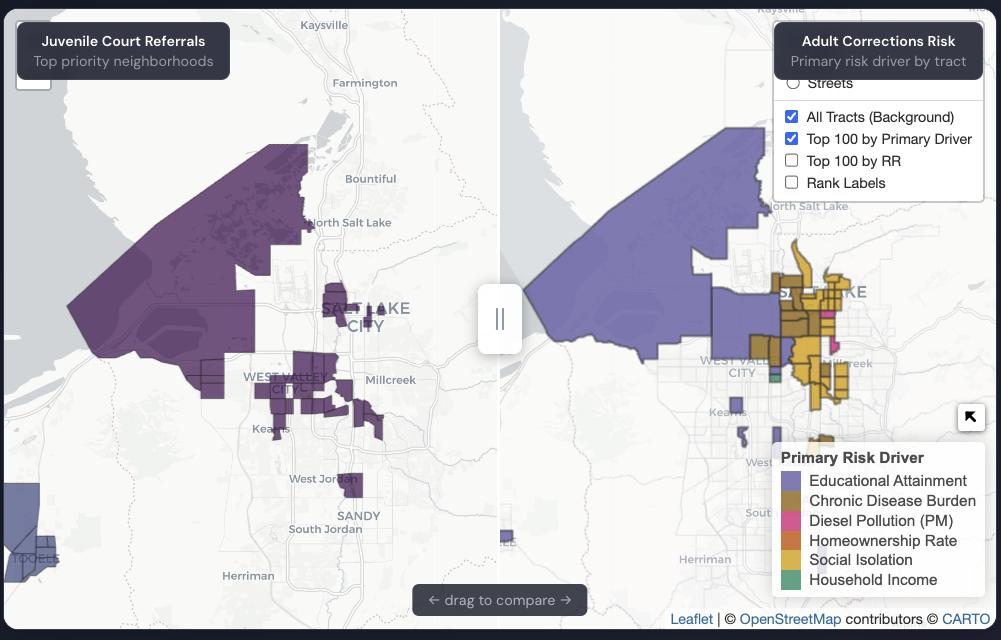
Juvenile Court Referrals (left) vs Adult Corrections Risk (right) · Salt Lake County
The neighborhoods where youth are most at risk have the least access to protective factors. Juvenile court referral hotspots and adult correctional risk converge in the same census tracts. Our spatial analysis maps 8 layers of community protective infrastructure. The same tracts appear highest-risk across nearly every layer.
Where you grow up determines outcomes
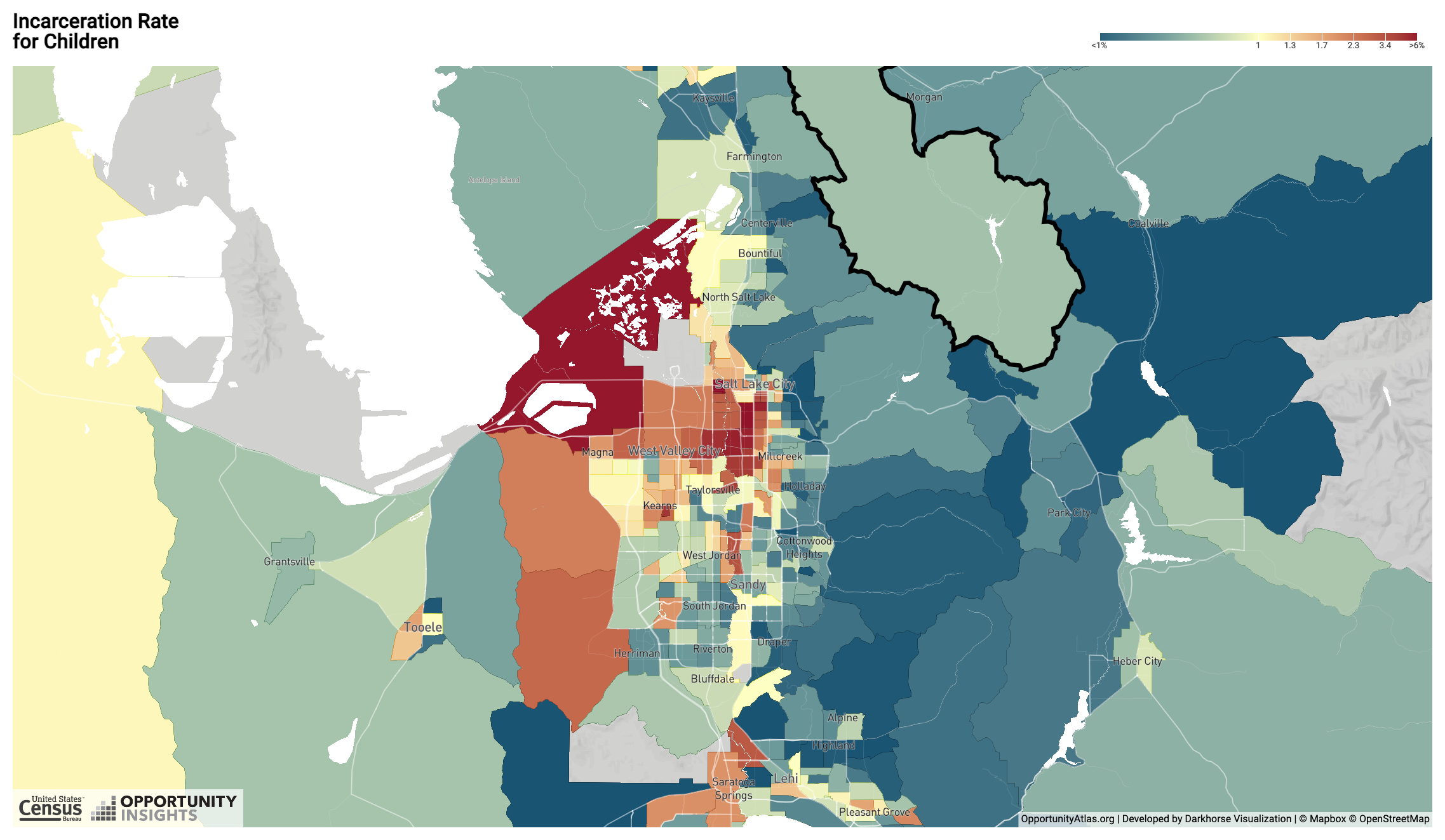
Opportunity Atlas · Incarceration rate, 1978-1983 cohort
Children who grew up in SLC's west-side tracts were incarcerated as adults at the highest rates. These trends are intergenerational. The conditions have not changed for the current generation.
Education confirms the same pattern
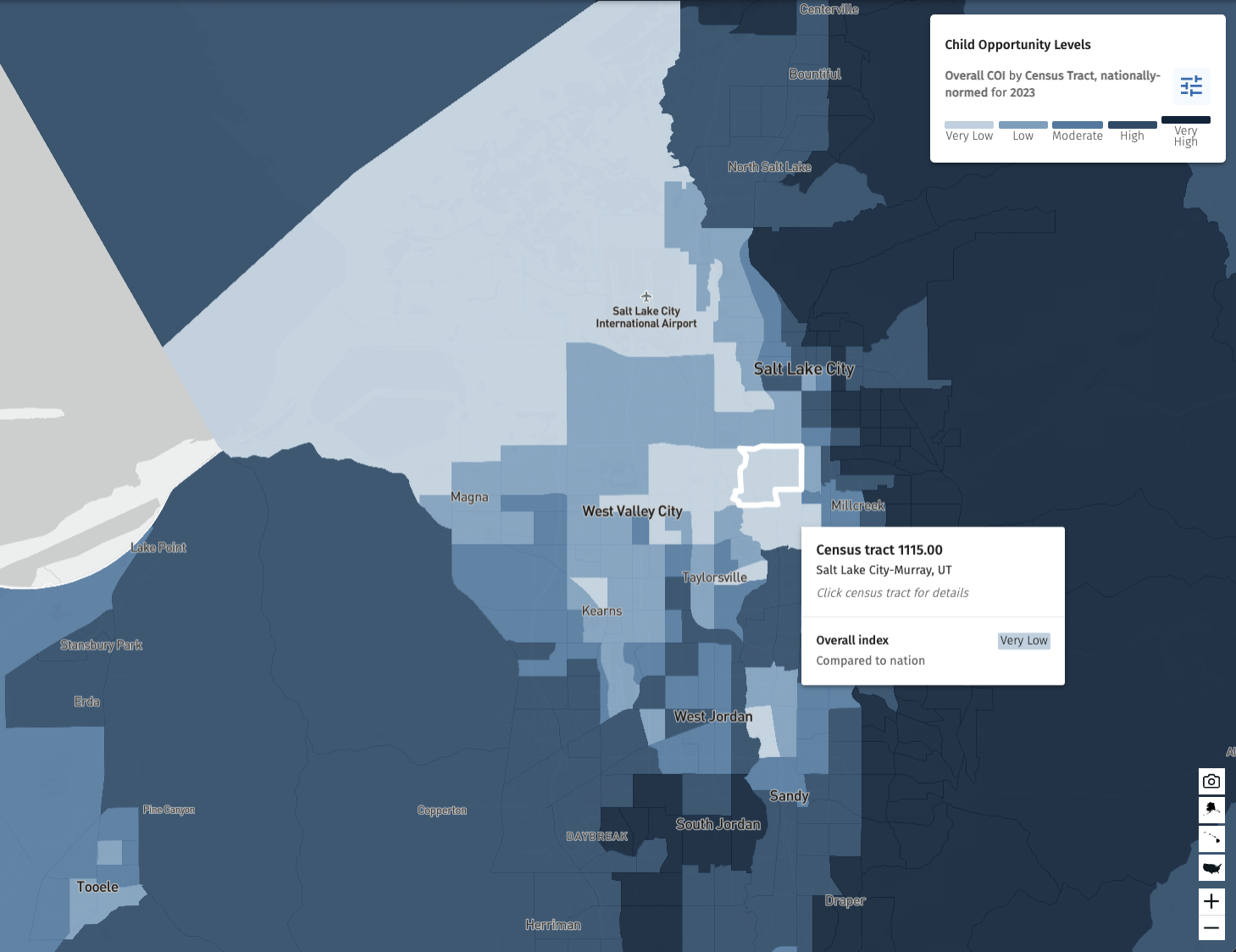
Child Opportunity Index 3.0 · diversitydatakids.org
8/100Education domain overall
21/100Early childhood education
10/100Elementary education
Place is not a backdrop. It is the mechanism.
Utah Commission on Criminal & Juvenile JusticePage 2
2
The Mechanism — The developmental pathway
Adverse childhood experiences are situated in place. Place can amplify the risk.
→
→
Brain dev.
Prefrontal cortex
→
→
Discipline
Suspension / LE
→
Upstream structural conditions
Poverty, housing instability, food insecurity, community violence, parental mental health/substance use, and incarceration in the family produce chronic stress that becomes ACEs. Scarcity narrows cognitive bandwidth.
Mani, Mullainathan, Shafir (2013). Science
Undiagnosed conditions drive behavior
5× higher behavioral risk for neurodevelopmental disorders (AAP 2025). ADHD (3.1× justice involvement), undiagnosed ASD, and dyslexia all present as "behavioral problems" when unscreened.
Intergenerational transmission
Parents with 4+ ACEs → children with 3.22× higher odds of conviction before age 26. The cycle is intergenerational and geographic.
Merrick et al. (2023). JAMA Network Open
The layered approach
RJ reduces suspensions but can't eliminate poverty. Mental health alone doesn't reduce reoffending. Strongest results: economic stability + family support + school climate + mental health + diversion.
Three windows of intervention
Early development
3.1×
ADHD → justice. Widest window.
School environment
16%
suspension ↓ (RAND RCT)
Community safety net
9%
murder ↓ per 10 orgs/100K
What youth actually need
🏠
Basic needs
met at home
Housing, food, adults not in crisis
🤝
A stable person
in their life
Mentor at age 4, not PO at 16
🔗
Someone who
connects them
Bridge to resources via trust
👨👩👧
Family trust
with system
Embed in orgs they use
⚠️ Emerging risk: social media
Social media accelerates risk, but it doesn't create it. Youth with strong prosocial connections are more resilient. The underlying vulnerability is the same community-level condition our maps measure.
Utah Commission on Criminal & Juvenile JusticePage 3
3
The Response — What's already working
Local evidence · Salt Lake County
Promise South Salt Lake
14 afterschool sites, 2,700 students, 3-6 PM daily. Inspired by the Harlem Children's Zone. LE officers serve as mentors. Schools, social workers, and LE all refer students.
Fills the 2-6 PM gap, builds protective factors through SEL, provides diversion pathways, and connects families to upstream services.
Continuity of care
Friends of the Children — Utah
Paid professional mentor for 12+ years starting at age 4. A probation officer arrives at the final stage. A Friend arrives at age 4. The stable, trusted relationship that intercepts the trajectory before it begins.
What we're doing
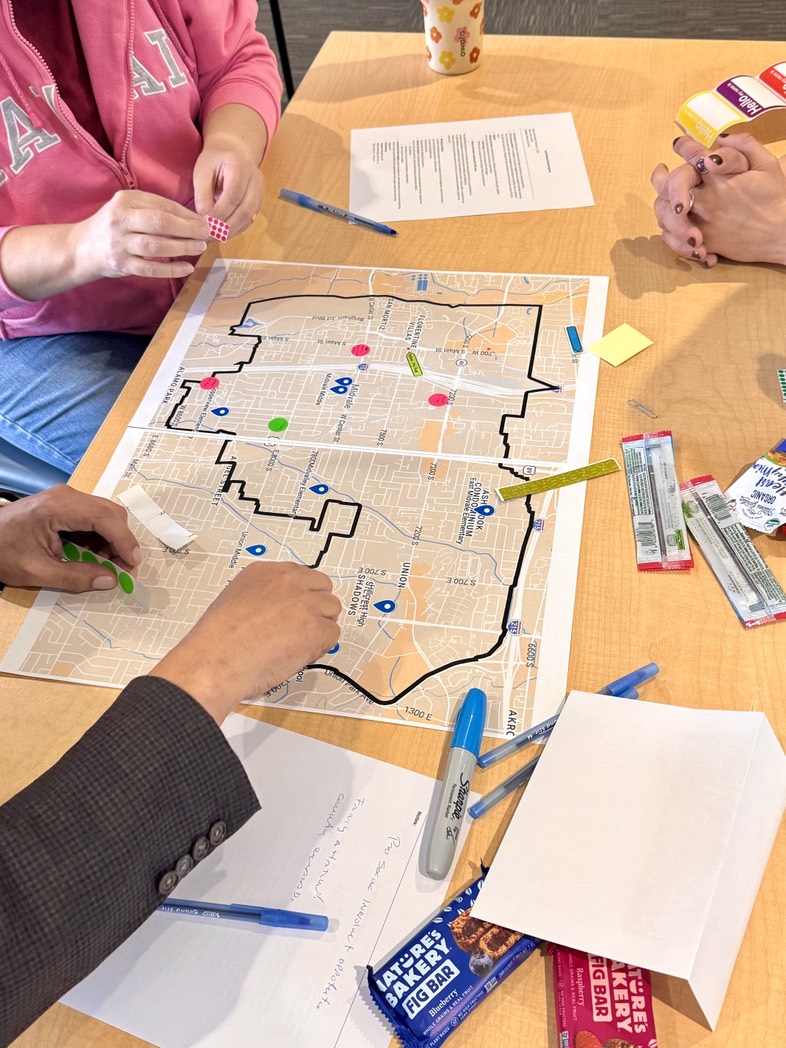
Community research walks: bringing the data to the neighborhoods
Modeled after Newark's DICE model (BJA-funded). Walking care desert tracts with residents, service providers, and local leaders to validate the data and co-produce intervention strategies.
📍 Midvale · Ogden
Walking care desert tracts with community partners to identify service gaps, validate findings with residents, and connect spatial evidence to intervention design. In partnership with local coalitions, county government, CCJJ is engaging educators, families, and stakeholders through focus groups, participatory mapping, and community research walks.
🎯 Place-based intervention matching
The interception window framework translates spatial analysis into targeted action:
5
Deploy where
return highest
Every young person deserves the chance to grow up safe.
The data shows us where to invest so communities can provide what youth need most.
Utah Commission on Criminal & Juvenile Justice
justice.utah.gov/research-analysis/jj-spatial/
Page 4